Your CRM Says You Have $4 Million in Pipeline. You Probably Don't.
A salesperson carries a $1 million annual target.
Management wants four times pipeline coverage.
The CRM shows $4.2 million.
On paper, the situation looks reassuring. There is enough opportunity in the system to produce the required revenue even if a large percentage of deals are lost.
Then somebody looks more closely.
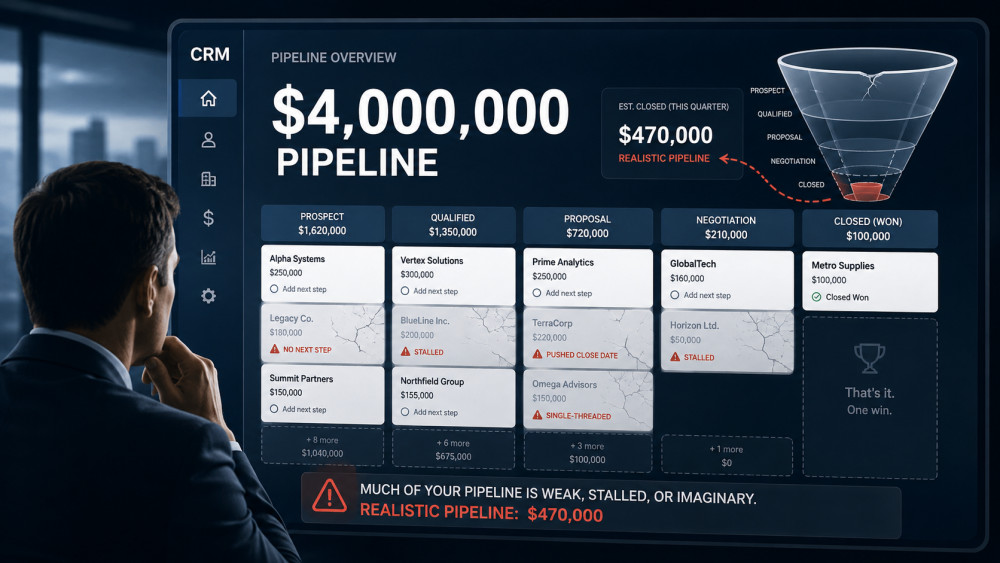
Nine hundred thousand dollars has not had meaningful customer activity in two months. Another $700,000 consists of opportunities whose close dates have moved several times. Half a million dollars has no identified economic buyer. Several proposals were sent without any agreed decision date. One large opportunity depends almost entirely on a single enthusiastic contact.
The dashboard still says $4.2 million.
But does the company actually have $4.2 million in pipeline?
This is one of the central problems with CRM. The software gives uncertain future events the visual appearance of hard assets.
Every opportunity has a company name, dollar amount, stage, probability and expected close date. The fields are precise enough to feel factual.
They are not.
Pipeline is a collection of assumptions about things customers may do in the future.
Some of those assumptions are well supported.
Others are fantasies with excellent data hygiene.
Two $250,000 opportunities can be almost unrelated economically
Imagine two deals with identical values.
In the first, the customer has acknowledged a painful problem. Several stakeholders are involved. The CFO knows about the initiative. The salesperson understands how a decision will be made. Commercial terms have been discussed, legal review is scheduled and the customer has a business reason to complete the project this quarter.
In the second, a director liked the demonstration and requested a proposal. That proposal was sent six weeks ago. Communication has become intermittent. Nobody has spoken with finance, procurement has not appeared and the close date has already changed twice.
CRM may display both as $250,000 opportunities.
Anyone looking at the business knows they are not remotely equivalent.
This is why pipeline quantity without pipeline quality can create dangerous confidence.
Leadership believes there is sufficient coverage. Sales managers assume the team merely needs to “execute.” Hiring and spending decisions may be made against anticipated revenue.
If too much of that pipeline is weak, the problem becomes visible only after there is no longer enough time to replace it.
Stage probabilities often contain less science than they appear to
Many CRMs assign probabilities automatically.
Discovery is 20 percent.
Demo is 40 percent.
Proposal is 60 percent.
Negotiation is 80 percent.
A weighted pipeline report then multiplies each opportunity by its probability and produces an impressively precise forecast.
The obvious question is where the probabilities came from.
Actual historical performance?
Or did someone choose round numbers during CRM implementation because the software required them?
A proposal-stage opportunity at one company may close 70 percent of the time because proposals are only produced after rigorous qualification.
At another company, salespeople may send proposals to virtually anyone who asks for pricing, producing a 15 percent conversion rate.
The word “proposal” does not carry a universal probability.
The same is true of every stage.
If organizations want meaningful weighting, they need to study their own historical conversion patterns rather than importing generic assumptions.
Otherwise the model is mathematically precise and commercially meaningless.
Activity can disguise stagnation
One of the easiest mistakes in pipeline management is confusing activity with progress.
An opportunity can generate dozens of emails, multiple calls, revised proposals, internal meetings and considerable salesperson effort while making almost no actual movement toward a customer decision.
Progress should be measured through changes in customer commitment.
Has another stakeholder become involved?
Has budget been discussed?
Did the customer complete technical validation?
Has procurement entered?
Did the buyer agree to a timeline?
Has the customer invested time, information, internal resources or political capital to move the initiative forward?
Sales activity tells us the seller is working.
Buyer activity tells us whether the deal is advancing.
Those are not the same thing.
Close dates should be tied to events, not optimism
Ask a salesperson why an opportunity is expected to close September 30.
There should be a reason.
Perhaps the customer's existing contract expires in October and implementation requires two weeks. Maybe a board meeting occurs September 15. Perhaps the buyer must have equipment operational before a November production run.
Those are customer-driven dates.
“September seems realistic” is not.
The more often a close date moves without a corresponding customer event, the less confidence anyone should place in it.
This does not mean every delayed deal is doomed. Real transactions encounter delays.
It means the date should tell a story about the customer's process rather than the salesperson's need to keep the opportunity inside the current quarter.
If nobody can explain why a particular date exists, the company should probably stop treating it as information.
Single-threaded deals are much weaker than they look
One enthusiastic champion can create tremendous momentum early in a sale.
It can also create false security.
Complex business purchases rarely depend on one person. Finance may care about economics, operations about implementation, IT about security, procurement about terms and senior executives about organizational risk.
A salesperson who knows one enthusiastic director but nobody else may not possess a $500,000 opportunity.
They may possess a $500,000 introduction.
This is why good pipeline reviews ask questions beyond “How does your contact feel?”
Who can approve the purchase?
Who can veto it?
Who controls the money?
Who will implement the solution?
Who benefits?
Who could lose political capital if the project goes badly?
Who have we not spoken with?
Multi-threading is not simply a sales tactic. It is evidence that the opportunity has penetrated the organization deeply enough to survive changes in one relationship.
Proposals are particularly deceptive
The proposal stage often receives a high probability because it feels close to a transaction.
But customers request proposals for many reasons.
Sometimes they intend to buy.
Sometimes they need pricing for next year's budget.
Sometimes procurement requires competing quotes.
Sometimes they want leverage against an incumbent.
Sometimes they are curious.
A proposal becomes meaningful when it is connected to a decision process.
Who will review it?
What happens after they review it?
What criteria matter?
Which objections remain?
When will a decision be made?
Without answers to those questions, the company may be mistaking document delivery for sales advancement.
A smaller pipeline can be healthier
This is where management psychology becomes important.
Suppose a salesperson conducts a serious review and removes a million dollars of weak opportunities. Their pipeline falls from $4 million to $3 million overnight.
Did the business deteriorate?
No.
The information improved.
There is enormous strategic value in that distinction.
A company that discovers in September that it has a $1 million pipeline shortfall can respond. It can increase prospecting, reallocate resources, involve executives in important opportunities, create campaigns, change territory focus or revise the forecast.
A company that discovers the same shortfall on December 20 because everyone spent the quarter pretending the pipeline was healthy has very few options.
Bad news discovered early becomes management information.
Bad news discovered late becomes an explanation.
Give the pipeline a haircut
Take the current pipeline and challenge it.
Flag everything with no meaningful recent customer interaction.
Examine every repeatedly pushed close date.
Look closely at single-threaded opportunities.
Challenge proposals without agreed decision processes.
Ask whether every large deal has a business reason to act.
Do not delete legitimate future opportunities simply because they are not ready now. Nurture them, move them appropriately and revisit them when circumstances change.
But stop counting possibility as current pipeline.
Maybe the $4 million becomes $2.3 million.
That number may be uncomfortable.
It is also far more useful.
The purpose of CRM is not to reassure the organization that enough revenue exists somewhere in the future.
It is to help the organization see commercial reality while there is still enough time to influence it.
A smaller truthful pipeline will beat a larger imaginary one every time.