The Discounting Paradox:
When Lower Prices Can Produce More Profit
Salespeople are often taught to treat discounting as a kind of moral failure.
Hold the line. Protect the value. Never train the customer to negotiate. If someone asks for a lower price, sell harder rather than discounting.
There is wisdom in that advice. Discounting can absolutely destroy margins, weaken positioning and teach customers that the first price was never real.
But “never discount” is not a pricing strategy. It is a slogan.
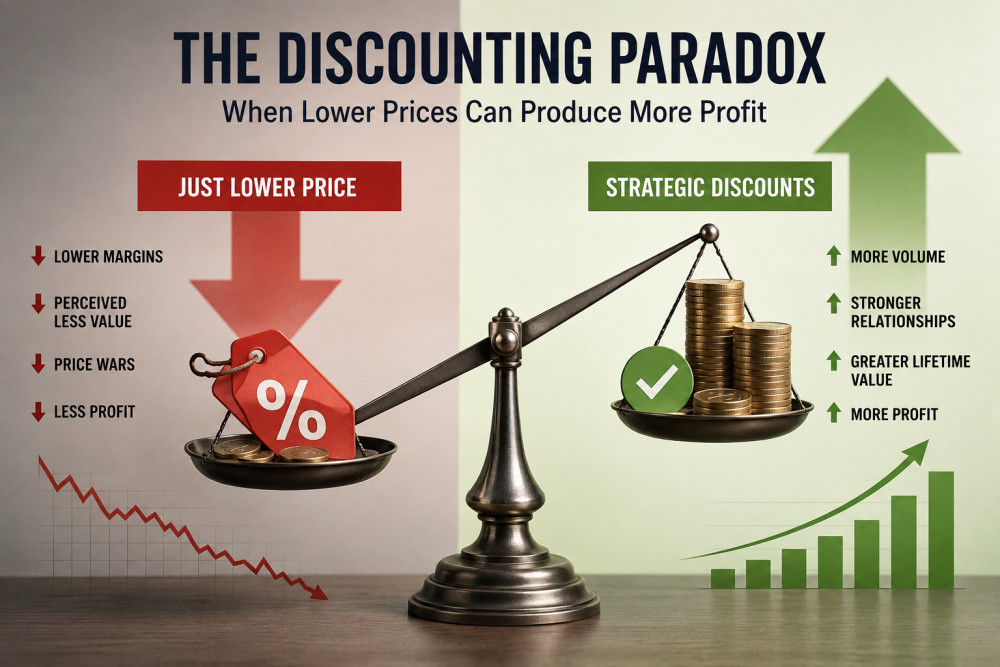
The more interesting question is whether a lower price can, under the right circumstances, improve the economics of the business. In some cases it can. A discount may increase volume, accelerate a decision, improve capacity utilization, generate repeat business, create a foothold in a strategic account or produce greater total gross profit even though the margin percentage on the individual transaction falls.
The difficulty is distinguishing strategic discounting from simply giving money away.
Start with the economics, not the percentage
Imagine a product that sells for $100 and has $50 in variable cost.
At full price, the company earns $50 in gross profit per unit. Sell 100 units and you generate $10,000 in revenue and $5,000 in gross profit.
Now suppose a 10 percent discount increases demand substantially. The selling price drops to $90 and gross profit falls to $40 per unit. If that lower price allows the company to sell 140 units, revenue rises to $12,600 and gross profit rises to $5,600.
The margin percentage went down.
The amount of gross profit went up.
That does not mean the company should automatically discount. The example simply illustrates why margin percentage cannot be evaluated in isolation.
Demand elasticity matters. So do fixed costs, unused capacity, customer acquisition expense, repeat purchases and lifetime value.
For a hotel with an empty room tonight, the economics of discounting are very different from those of a manufacturer whose production line is already operating at full capacity.
For a SaaS business with relatively low incremental delivery costs, a discount used to win a five-year enterprise customer may have different economics from a professional-services business where every additional sale requires scarce labor.
The right answer depends on what the company is actually trying to optimize.
A good discount is an exchange, not a surrender
One of the cleanest ways to think about discounting is to ask what the business receives in return.
If a customer wants a concession, perhaps the seller receives more volume, a longer contract, faster payment, prepayment, a quicker decision, reduced scope, standardized implementation, a case study, reference participation or expansion into additional locations.
That changes the nature of the conversation.
“Can you take 10 percent off?”
“Possibly. If we were able to do that, could you commit to a two-year agreement rather than one?”
The customer receives economic value. The seller receives economic value.
Contrast that with a salesperson who hears the first objection and immediately says, “Let me see what I can do on price.”
The second behavior teaches the buyer something dangerous: the original number may not have meant very much.
Customers are rational to wonder what else is available once they discover the first price moves easily.
Could we get another 5 percent?
What happens if we wait?
Did other customers pay less?
Was the original price inflated simply to create negotiating room?
At that point, the salesperson is no longer negotiating one transaction. They are renegotiating the credibility of the company's entire pricing model.
A discount needs a reason
The explanation attached to a discount can matter almost as much as the amount.
Consider these two statements:
“Our price is $50,000, but I can probably get you down to $43,000.”
And:
“We're filling the final two implementation slots for this quarter. If your team is comfortable making the decision by September 30 and beginning implementation in October, we have authorization to provide an incentive for those slots.”
Both may result in a lower price.
The second creates a business rationale.
That matters because it separates the concession from the underlying value of the product. The price is different because the circumstances of the transaction are different.
Seasonal promotions work on the same principle. Volume discounts have an economic explanation. Annual prepayment incentives have an economic explanation.
Random discounting does not.
Without a reason, a discount can inadvertently communicate that the seller was hoping to get more but was willing to accept less.
If there is no deadline, it probably isn't an incentive
A discount intended to accelerate a decision should have a legitimate expiration.
Otherwise the customer has no reason to accelerate anything.
This is where companies often undermine themselves. The salesperson offers a “special” price if the customer signs by the end of the month. The end of the month arrives. The customer does nothing.
Then the salesperson extends the same offer.
Another deadline passes.
The discount remains.
The customer learns an important lesson: deadlines are theater.
If the offer remains available forever, the company did not create an incentive. It reset the price.
This does not mean manufacturing fake scarcity. False urgency can be more damaging than no urgency at all. The condition should be real and connected to a genuine business reason.
If implementation capacity opens next quarter, say so. If a promotion expires, allow it to expire. If the economics depend on a larger commitment, explain that.
Credibility compounds too.
“Too expensive” is not a diagnosis
The greatest danger in discounting is assuming every pricing objection is actually about price.
When a buyer says, “That's too expensive,” they may mean the budget genuinely cannot accommodate the purchase.
They may mean a competitor is cheaper.
They may be required by procurement policy to negotiate.
They may simply be testing you.
But “too expensive” can also mean, “I do not see enough value.”
Those are different situations.
Suppose a buyer believes your solution is worth $20,000 and you are charging $40,000. Reducing the price to $36,000 does not solve the fundamental problem. It merely makes an unconvincing value proposition slightly cheaper.
Before making a concession, understand what the objection represents.
Sometimes the correct response is a discount.
Sometimes it is a better explanation of value.
Sometimes the customer is simply not a good fit.
Some discounted business is business you should not want
Sales organizations naturally focus on the question, “What will it take to win?”
They should also ask, “Should we want to win under these conditions?”
A heavily discounted customer can become expensive after the sale. Perhaps they require a disproportionate amount of support. Maybe they repeatedly renegotiate. Their implementation consumes scarce resources. Their renewal becomes another pricing battle.
The sales team celebrates the booking.
Everyone else inherits the economics.
This is one reason discount authority should be designed carefully. If a salesperson is paid almost entirely on topline revenue and suffers little consequence when margin falls, management should not be surprised when discounting becomes a preferred closing technique.
The incentive system is telling the salesperson to behave that way.
Companies that care about margin need to build some awareness of margin into the compensation or approval structure.
The paradox is real, but it isn't magic
Strategic discounting can absolutely make sense.
A modest incentive may push a buyer under an approval threshold. It may accelerate cash flow. It may move unused inventory. It may generate enough volume to improve total gross profit. It may open a relationship that becomes substantially larger over time.
But the operative word is strategic.
The purpose of a discount is not to make the buyer happier by reducing the number on the page.
It is to create an economically valuable change in behavior.
If you discount, know why.
Know what you are receiving in return.
Know what happens to the economics.
Give the concession a credible explanation.
Attach a legitimate condition if the objective is urgency.
And remain willing to walk away from business that no longer makes sense.
Price is one of the most powerful signals a company sends to the market. Treating it casually because a salesperson wants an easier path to “yes” can cause damage that lasts far beyond one transaction.
Sometimes the right discount creates more value for both sides.
Sometimes the most profitable discount is the one you refuse to give.