The Most Expensive Deal in Your Pipeline Is the One You Should Have Killed 60 Days Ago
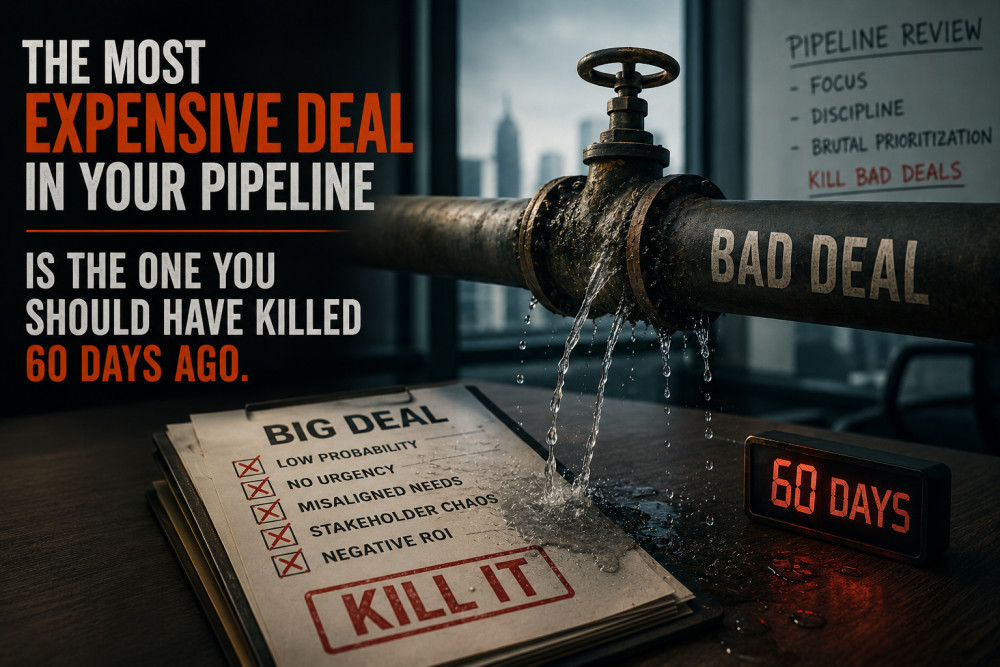
Somewhere inside almost every sales pipeline is an opportunity that everybody knows is in trouble and nobody wants to close.
At one point it was real. There was a productive conversation, perhaps a strong demo, genuine interest and enough encouragement that the salesperson put a meaningful dollar value into CRM.
Then momentum slowed.
A meeting was postponed. The promised introduction to the CFO never happened. The customer asked for a proposal and went quiet. The projected close date slipped from June into July, then from July into September.
Nobody formally said no, so the opportunity survived.
It is still discussed in forecast meetings. The salesperson still sends occasional follow-ups. The manager still asks, “Any movement on Acme?” The close date occasionally gets adjusted to keep it from becoming obviously absurd.
The deal is not alive in any meaningful commercial sense.
But it continues consuming organizational attention.
That is why the most expensive opportunity in your pipeline may not be the giant deal you ultimately lose to a competitor. At least that transaction reaches a conclusion.
The expensive one is the deal that died two months ago and keeps billing you for time.
Dead opportunities have an opportunity cost
Salespeople have finite capacity.
A representative can only research so many accounts, conduct so many meetings, write so many proposals, build so many internal relationships and thoughtfully pursue so many opportunities at once.
That means every hour has an alternative use.
If I spend 45 minutes preparing another follow-up for an opportunity with almost no evidence of forward movement, that time cannot be spent developing an active account or creating a new one.
This seems obvious, yet sales organizations frequently behave as though pipeline has no carrying cost.
It does.
A dead deal occupies salesperson time. It appears in manager reviews. Sales engineers may remain involved. Revised pricing gets created. Forecasts are adjusted. Executives discuss it. CRM administration continues.
None of those activities is enormous individually.
Over 30, 60 or 90 days, they add up.
The greatest cost, however, is invisible: the revenue-generating work that did not happen because everyone's attention remained attached to an opportunity that was no longer moving.
Sunk cost is a powerful drug
There is a reason experienced salespeople struggle to let these deals go.
They remember what the opportunity looked like when it was promising.
Perhaps they spent three months developing the relationship. They flew somewhere for a meeting. Senior leadership became involved. They built a custom demonstration. Maybe it represents a substantial percentage of their annual quota.
Closing the opportunity now feels like declaring all of that effort wasted.
Economists have a name for this: sunk-cost thinking.
Past investment influences a decision that should be based on future economics.
A useful question cuts through it:
If this opportunity were presented to me for the first time today, knowing everything I currently know, how much time would I choose to invest in it?
That is a very different question from, “How much have I already invested?”
The hours you spent last quarter are gone regardless of what you do next.
The decision is about the next hour.
Interest is not commitment
One of the most dangerous phrases in pipeline reviews is, “They're still interested.”
They may be.
Interest does not equal buying motion.
People are interested in many things they never purchase. A prospect can genuinely enjoy your presentation, believe the product is impressive, like you personally and still decide that solving the problem is not important enough to justify action.
The more useful question is what the customer has done.
Have they introduced another stakeholder?
Shared information needed to evaluate the solution?
Discussed budget?
Allocated internal resources?
Brought procurement or legal into the process?
Agreed to a meaningful next step?
Committed to a timeline?
Customer behavior is far more informative than customer politeness.
A friendly prospect who repeatedly says, “Yes, we're still very interested” while doing nothing for eight weeks may be telling you the truth. They are interested.
They simply are not buying.
Watch what happens to the close date
Repeated movement in projected close dates is one of the clearest signs that the story surrounding an opportunity is diverging from reality.
Real deals get delayed, of course. Budgets shift. Executives travel. Legal review takes longer than expected. Unexpected operational issues arise.
A moved close date is not automatically evidence of a bad deal.
What matters is why it moved.
If the customer gives you a concrete reason and a new event is driving the revised schedule, there may be no problem.
If June became July because “they needed more time,” July became August because “a few people were on vacation,” and August became October because “Q4 is probably more realistic,” the close date is no longer forecasting customer behavior.
It is preserving salesperson hope.
One useful discipline is to require a customer-derived explanation for every meaningful close date.
Why September 30?
What will occur between now and then?
What event makes that date credible?
If there is no answer, there may not be a close date at all.
Pipeline reviews should include a category called “kill”
Managers spend a great deal of time asking salespeople how they will advance deals.
They should spend more time asking which deals no longer deserve advancement.
A simple framework is to divide questionable opportunities into three categories: advance, rescue or kill.
An advance opportunity has credible buying motion. The customer is engaged, the problem matters and there is a defined path forward. Continue investing.
A rescue opportunity was once legitimate but has lost momentum. The wrong response is endless “just checking in” emails. The salesperson needs clarity.
That may require a much more candid message:
“We've had several productive conversations, but it looks as though this may no longer be a priority. Rather than continue chasing you, should we close this out for now?”
Sometimes the answer will be yes.
That is useful information.
Occasionally the customer responds immediately: “No, don't close it. Here's what happened.”
That is useful information too.
A kill opportunity has no credible current buying motion. Close it.
If something changes later, reopen it.
CRM is not supposed to be a historical monument to every positive conversation a salesperson has ever had.
Managers create zombie pipeline too
Salespeople are not solely responsible for bad pipeline hygiene.
Managers often train them to preserve weak opportunities.
Imagine a salesperson walks into a forecast meeting with $3 million in pipeline and removes $900,000 worth of questionable deals.
The manager reacts badly.
“What happened to all your pipeline?”
Nothing happened that day.
Reality simply became visible.
If representatives learn that honesty makes them look worse, they will learn to preserve fiction. Close dates will move. Stages will remain artificially high. Opportunities will linger because removing them produces more immediate pain than leaving them alone.
Then leadership wonders why the forecast is unreliable.
Forecast accuracy is partly a cultural outcome.
Organizations that want accurate pipeline have to make it psychologically safe to report bad news before the end of the quarter.
Disqualification deserves more respect
Sales training spends enormous energy teaching people to qualify opportunities.
Far less attention goes toward teaching them to disqualify.
Yet the ability to walk away is one of the clearest signs of sales maturity.
A salesperson who believes every prospect must somehow be converted will waste extraordinary amounts of time.
A salesperson who recognizes that only a small percentage of potential customers deserve significant investment becomes more selective.
That selectivity is not pessimism.
It is resource allocation.
The paradox is that saying no more often can help a salesperson produce more revenue because the time previously spread across dozens of weak opportunities becomes concentrated on a smaller group of credible ones.
The next time you review pipeline, therefore, do not limit the conversation to “What can we close?”
Ask another question:
“What should we stop working on?”
There is often a surprising amount of revenue hiding inside the answer.