Your Sales Funnel Is Leaking:
Where Revenue Quietly Disappears Before You Ever Lose the Deal
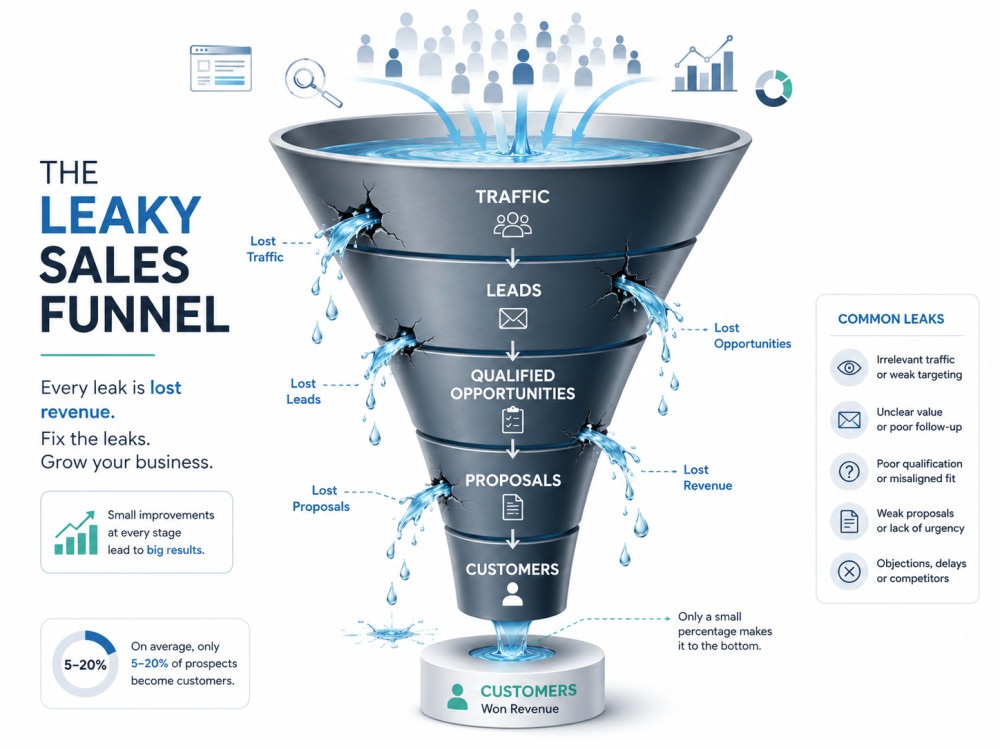
When sales begin to soften, most companies look immediately toward the top of the funnel. They increase advertising, ask marketing for more leads, buy another prospecting database, tell salespeople to make more calls, or start discussing whether it is time to hire additional reps.
Sometimes that is exactly the right response. But there is another possibility that receives much less attention: the company may already be generating enough interest. It may simply be doing a poor job converting that interest into revenue.
Before pouring more water into the bucket, in other words, it is worth checking for holes.
Sales funnels rarely fail in one dramatic place. Revenue tends to disappear gradually, in small increments, as potential customers move from one stage to another. A few prospects never receive a timely response. A few more are handed from marketing to sales without enough context. Others speak to a representative who fails to understand what they actually need. Some have a good first conversation but leave without a defined next step. Others request a proposal and then drift indefinitely into the CRM equivalent of suspended animation.
Individually, none of those losses may look catastrophic. Collectively, they can represent an enormous amount of money.
Consider a simplified funnel. Suppose 10,000 people encounter your company, 20 percent engage, half of those become qualified opportunities, half agree to a substantive sales conversation, half eventually receive a proposal, and 20 percent of those buy. That produces 50 customers.
Now imagine improving each transition modestly. Not doubling conversion. Not creating some miraculous sales transformation. Just making each handoff slightly better. Because funnels compound, those incremental gains can produce a surprisingly large increase in customers without generating a single additional visitor or lead.
That is what makes funnel leakage so interesting. Companies often assume that growth requires creating more opportunity when the cheaper answer may be converting more of the opportunity they already paid to create.
Start with the moment of interest
One of the simplest leaks occurs immediately after a prospect raises a hand.
Someone requests information, starts a chat, asks for pricing, downloads something significant, schedules a demonstration, or fills out a contact form. At that particular moment, your company occupies a meaningful amount of their attention.
Then nothing happens.
Perhaps the inquiry sits in a queue. Maybe there is confusion about who owns it. A routing rule fails. The salesperson is busy. The lead is assigned at the end of the day and contacted the following morning.
By then, the prospect may have visited three competitors, held two internal meetings and moved on to a different problem.
Organizations frequently have service-level expectations for lead response, but the useful question is not what the policy says. The useful question is what actually happens. Take a random sample of inquiries and measure the elapsed time between a customer's request and a meaningful human or intelligent response.
You may be surprised.
The same scrutiny should be applied to the handoff between marketing and sales. This is one of the oldest sources of friction in business. Marketing complains that sales ignores leads; sales complains that marketing sends garbage. Both departments can produce impressive statistics supporting their position while the prospect receives a mediocre experience.
From the customer's perspective, of course, there are no departments. There is only the company.
A lead can be good when it arrives and bad by the time you finish with it
Another leak is more uncomfortable because it forces the sales organization to examine itself.
Companies tend to treat conversion rates as a referendum on lead quality. If 100 prospects enter the funnel and only ten advance, the instinct is often to conclude that the other 90 were poor opportunities.
Some undoubtedly were.
But how many became poor opportunities because of the sales interaction?
A company might spend hundreds of dollars attracting a potentially valuable prospect, only to place that person in front of a salesperson who is underprepared, asks generic questions, knows little about the prospect's business, and seems more interested in completing an internal qualification process than helping the buyer.
The CRM later records the result as “not interested.”
That phrase deserves more curiosity than it usually receives. Was the prospect not interested when they arrived, or did we make them less interested after they got here?
This distinction matters because conversion rates do not measure buyers alone. They also measure the effectiveness of the experience we create for them.
One of the easiest improvements is surprisingly mundane: establish a real next step before ending a substantive conversation. “I'll follow up” is not a next step. Neither is “Let's reconnect soon.”
Who is doing what? By when? Why does it matter? What decision or activity will that next interaction support?
A sales opportunity that ends every conversation in ambiguity begins decaying immediately.
The proposal graveyard
The proposal stage deserves special attention because it often creates a false sense of progress.
A prospect requests pricing. The salesperson creates a polished proposal, sends it over and records the opportunity as having advanced. Everyone feels closer to revenue.
Then comes the familiar exchange.
“Thanks. We'll review internally.”
Three days later: “Just checking in.”
A week later: “Wanted to circle back.”
Another week passes. The salesperson sends the increasingly desperate “bumping this to the top of your inbox.”
Eventually, the deal remains in CRM because nobody has technically said no.
The problem is rarely the follow-up email. The problem usually occurred before the proposal was delivered.
Did the salesperson understand who would evaluate it? Were the decision criteria known? Had the remaining objections been identified? Was there a budget? Was there a reason the customer needed to act? Had the parties agreed on what would happen after the document was reviewed?
A proposal does not move a deal forward simply because it exists. Sometimes all the salesperson has done is distribute a PDF.
Some leakage comes from refusing to let bad opportunities die
There is another kind of funnel problem that looks like optimism but functions like waste.
Salespeople have limited time. Every hour spent chasing a prospect who is unlikely to buy is an hour that cannot be invested in finding or advancing a better one.
That means dead opportunities hurt twice. They fail to become revenue, and they consume the capacity that might have created revenue elsewhere.
A healthy funnel therefore depends not only on moving qualified buyers forward, but on removing unqualified or inactive opportunities quickly enough that they do not clog the system.
This is where management behavior matters. If salespeople are punished every time pipeline decreases, they learn to preserve weak opportunities. If managers demand “4x coverage” regardless of quality, reps will eventually find enough questionable deals to make the dashboard green.
The mathematics will look reassuring. The forecast will not.
Conduct a funnel autopsy
One of the most revealing exercises a sales organization can perform requires no new technology.
Take the last 100 leads or opportunities and follow each of them through the process.
How did they enter?
How long did the company take to respond?
Was meaningful contact established?
Did the prospect speak with the right person?
Was the opportunity actually qualified?
Did the salesperson establish a next step?
Was a proposal delivered?
Did the customer make a decision?
If the opportunity disappeared, where exactly did that happen?
Then calculate the conversion rates between those stages.
Do not begin with the assumption that something is wrong. Begin with curiosity.
The results may tell you that you genuinely need more demand. They may also reveal that demand is being generated and squandered.
Perhaps the largest leak is response time. Perhaps prospects disappear after the first meeting. Maybe demos convert well but proposals do not. Maybe salespeople are excellent at landing new customers but nobody systematically pursues expansion opportunities after the first sale.
Each leak suggests a different intervention.
That is far more useful than simply telling everyone to “sell harder.”
The most important question may therefore not be, “How can we generate 20 percent more leads?”
It may be, “What would happen if we converted 20 percent more of the opportunity we already have?”
For some companies, the answer to that question will be worth considerably more than another advertising campaign.
The fastest way to grow a funnel is not always to make the opening wider.
Sometimes you need to fix the plumbing.