AI Will Not Replace Salespeople. It Will Expose Them.
There is a comforting phrase making the rounds in business right now: “AI will not replace people. People using AI will replace people who do not.”
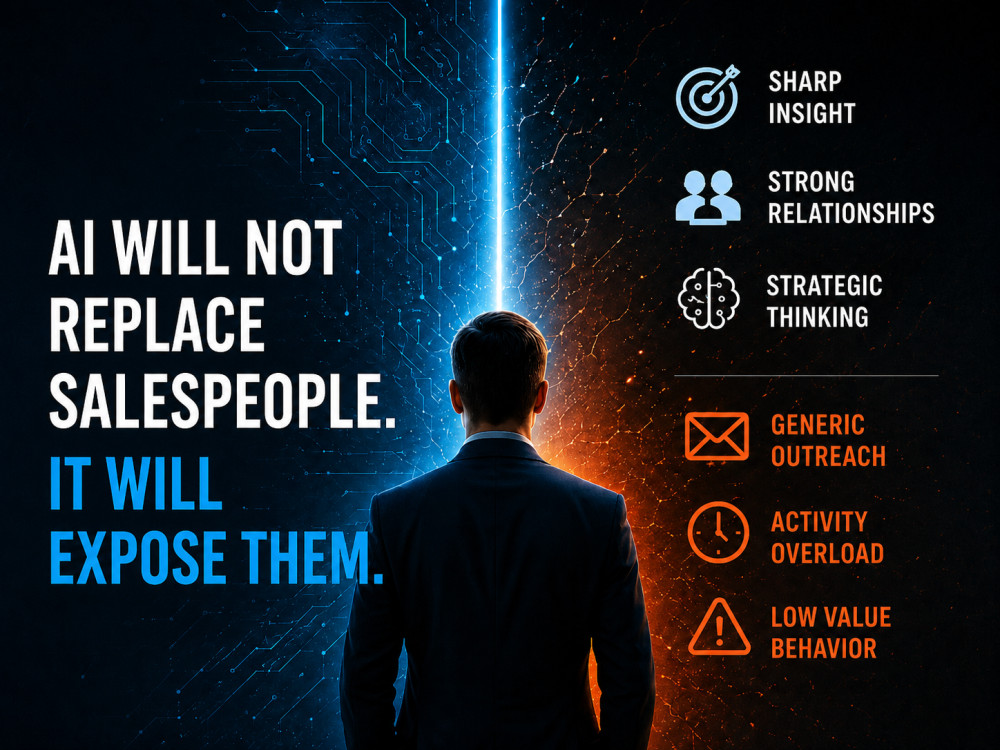
That is almost true. But in sales, the sharper version is this: AI will not replace salespeople. It will expose them.
It will expose salespeople who do not know their market. It will expose salespeople who confuse activity with progress. It will expose salespeople who send 900 generic emails and call it “pipeline generation.” It will expose managers who forecast based on optimism, vibes, and whatever Brad said in the Monday meeting. It will expose companies that hired “hunters” but accidentally built a team of professional calendar reschedulers.
AI is not just adding speed to sales. It is adding contrast.
The good salesperson using AI becomes more dangerous. The weak salesperson using AI becomes more annoying. That is a very important distinction.
A strong salesperson can use AI to research accounts, map buying committees, summarize earnings calls, identify trigger events, build sharper hypotheses, prepare better questions, and follow up with more relevance. A weak salesperson uses AI to generate a prospecting email that begins, “I hope this message finds you well,” and ends with the written equivalent of a beige conference room.
The tool is not the differentiator. Judgment is.
This is why the current AI moment is so fascinating for sales leaders. Every software vendor is promising productivity gains. More emails. More sequences. More call summaries. More automated notes. More lead scoring. More account intelligence. More “personalization at scale,” a phrase that should probably be illegal unless the sender can pass a basic test proving they know what personalization means.
But productivity is not the same as effectiveness.
If your sales team is already disciplined, AI can make the system better. If your sales team is sloppy, AI can make the slop travel faster. It is the difference between putting a turbocharger on a race car and putting a turbocharger on a shopping cart with one bad wheel.
This matters because buyers are not passively accepting the increase in seller automation. They are adapting too. Gartner’s 2026 research shows B2B buyers increasingly prefer rep-free experiences and are using AI tools in the purchase process. Forrester has also predicted that in 2026, one in five B2B sellers will be forced to engage in agent-led quote negotiations, where AI-powered buyer agents push sellers into more dynamic pricing and negotiation environments.
That is not science fiction anymore. That is the procurement department putting on a robot suit.
This creates a strange new sales battlefield. Sellers are using AI to reach buyers. Buyers are using AI to avoid sellers. Procurement may use AI to squeeze sellers. Sellers may use AI to defend price, articulate value, and create better counteroffers. Everyone is bringing software to a knife fight, and the winner will not be the person with the most automation. The winner will be the person with the clearest thinking.
For sales professionals, this means your career cannot be built on tasks that AI can do faster and cheaper. If your core value is logging notes, writing basic follow-ups, finding contact names, generating generic outreach, or summarizing meetings, your value is under pressure.
But if your value is interpreting business pain, building trust, navigating ambiguity, understanding power, creating urgency, negotiating tradeoffs, and helping buyers make complex decisions, AI is not your replacement. It is your exoskeleton.
The best salespeople will become part analyst, part consultant, part operator, part psychologist, and part detective. They will use AI not to avoid thinking, but to think better.
This is where a lot of teams will get it wrong. They will train reps to use AI tools, but not train them to ask better questions. They will measure more output, but not better outcomes. They will celebrate more touches, but not more conversations. They will automate follow-up, but not improve the quality of discovery. They will turn every rep into a mini content factory and then wonder why buyers feel like they are being hunted by a toaster.
The AI-enabled sales team of 2026 needs fewer hacks and more standards.
For example, before a rep sends AI-generated outreach, they should be able to answer: Why this account? Why now? Why this person? What business event makes the message relevant? What problem do we believe they have? What evidence supports that belief? What would make this message worth reading if I were the buyer?
If the rep cannot answer those questions, AI should not be allowed to help them send the email. It should gently close the laptop and suggest a career in interpretive dance.
For sales leaders, this creates a hiring challenge. The best sales hires are not necessarily the people who “know AI.” Everyone will claim they know AI. That will become as meaningless as saying “proficient in Microsoft Office” was in 2009.
The better hiring question is: does this person have the judgment to use AI well?
Can they distinguish useful information from noise? Can they write clearly? Can they think in business terms? Can they personalize without sounding creepy? Can they use research to form a hypothesis? Can they challenge a buyer respectfully? Can they explain complexity in plain language? Can they avoid outsourcing their personality to a chatbot?
The companies that win will not merely hire salespeople who can use tools. They will hire salespeople who can use tools in service of better selling.
There is also a cultural issue here. AI adoption fails when it is treated as either magic or surveillance. If reps believe AI exists only to monitor them, score them, replace them, or generate a dashboard that turns their day into a performance-anxiety aquarium, they will resist it. If leaders pretend AI will solve fundamental sales problems without better management, they will be disappointed.
AI is not a substitute for sales leadership. It is a stress test of sales leadership.
If your sales process is unclear, AI will not fix it. If your messaging is weak, AI will amplify it. If your ICP is fuzzy, AI will spray your fuzziness across the internet. If your managers do not coach, AI will simply produce prettier reports about underperformance.
But if you have clear positioning, a sharp ICP, strong managers, disciplined pipeline review, thoughtful enablement, and high standards for communication, AI can make the whole machine more powerful.
The future of sales is not human versus machine. It is disciplined human plus useful machine versus undisciplined human plus noisy machine.
That should be encouraging. Because the great salespeople still have the advantage.
They always did.