When Buyers Come In Educated:
Selling Value in a Post-Information Age
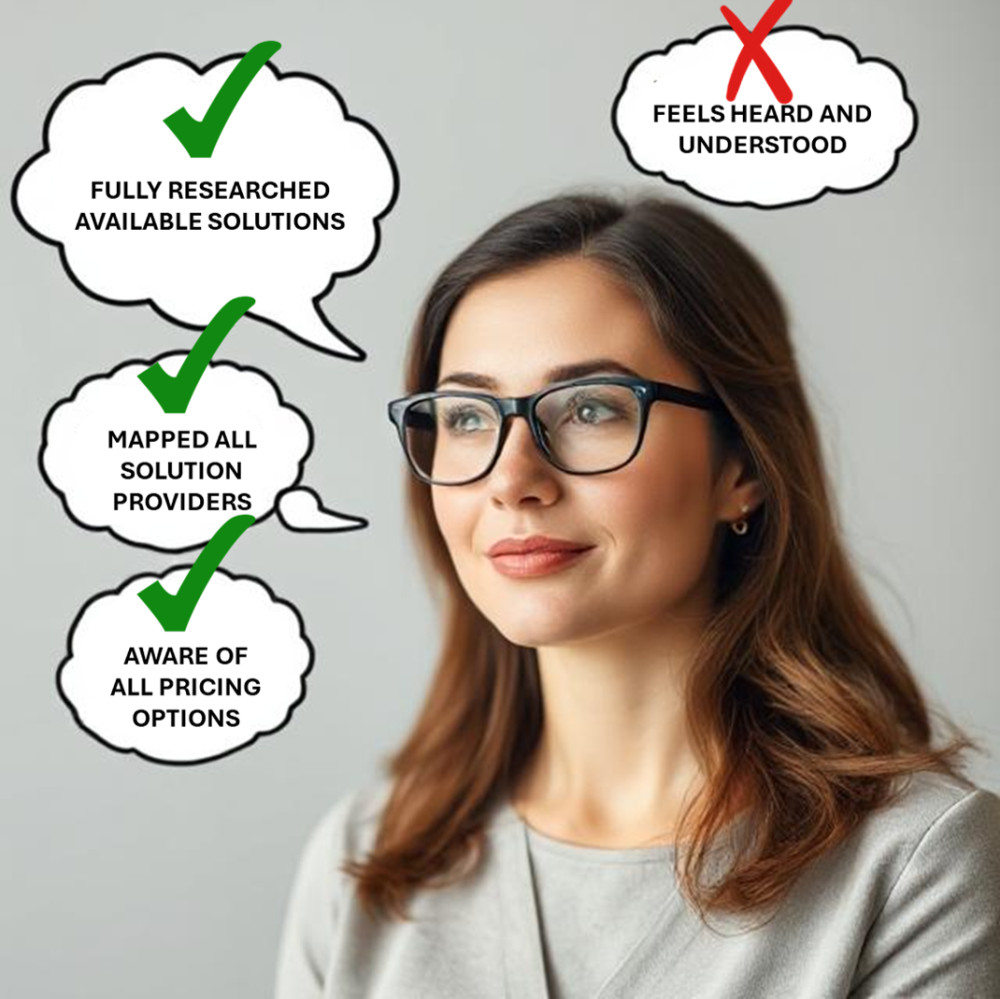
Information asymmetry is gone. Today’s buyers arrive with research, peer reviews, pricing context, and (often) a short list. Your advantage isn’t access to facts—it’s the ability to interpret, prioritize, and de-risk decisions. This article reframes the seller’s role and supplies discovery frameworks, collaboration artifacts, objection handling, and measurable outcomes.
1. The Shift: From Teaching to Translating
- Then: Sellers taught features; collateral was scarce; reps controlled pace and scope.
- Now: Buyers pre-qualify vendors alone. Your first live touch happens mid-journey. The job is to connect known information to business impact—fast.
2. The Modern Seller’s Job Description
- Sensemaking: Distill noise into 2–3 critical drivers tied to executive KPIs.
- Risk management: Identify failure modes and strategies to avoid them.
- Business case stewardship: Co-author ROI with the champion, not for them.
- Consensus choreography: Map hidden influencers; assign tasks via a mutual action plan (MAP).
3. Discovery for Educated Buyers (The 4-Layer Map)
- Situation Clarity: “Walk me through the top 3 outcomes leadership expects this quarter.”
- Constraint Reality: “If nothing changes in 90 days, what breaks first?”
- Value Signals: “Which cost buckets matter most to finance (hard dollars, time-to-value, risk)?”
- Decision Path: “Who can say ‘no’ late in the game? What would they need to see?”
Pro Tip: Replace “What keeps you up at night?” with “If I could guarantee one outcome in 60 days, which would move your forecast the most?”
4. Collaboration Artifacts That Win
- Decision Brief (1-pager): Problem, options considered, chosen path, KPIs, risks, mitigation. Written with the champion; used by the CFO.
- Mutual Action Plan (MAP): Dates, owners, verifiable milestones. Lives in a digital sales room; reduces “drift.”
- Impact Calculator: Inputs from the prospect; outputs include payback and sensitivity (best/base/worst).
- Pilot Charter: Scope, success criteria, sunset conditions, handoff to production.
5. Value Storytelling Framework (PAIN → COST → RISK → OUTCOME)
- Pain: “Lead-time volatility and missed SLAs.”
- Cost: “Each miss costs $X in penalties + churn risk.”
- Risk: “Without cross-team visibility, miss probability rises 18–22%.”
- Outcome: “With shared telemetry, we shrink misses by 40%, lifting gross margin 180 bps.”
6. Handling the “We’ve Done Our Homework” Objection
Use Acknowledge → Add → Ask:
- Acknowledge: “I’m glad you’ve compared options; that accelerates us.”
- Add: “Teams like yours often overlook supplier failover or change-management drag.”
- Ask: “Would it help if we pressure-test those two areas with your ops lead this week?”
7. Pricing Transparency Without Losing Leverage
- Publish bands; bring a choice architecture (Good/Better/Best) aligned to risk tolerance.
- Tie discounts to verifiable milestones (timeline, scope, references) to prevent endless concessions.
8. Pilot Design That Converts
- Keep to 30–45 days with 2–3 unambiguous KPIs.
- Require customer side resources up front (data access, SME time).
- Pre-agree production cutover triggers to avoid “successful pilot, no decision.”
9. Metrics for the Post-Information Era
- Decision latency (first live touch → executive decision)
- MAP adherence (on-time milestone rate)
- Consensus depth (stakeholders engaged by function/seniority)
- Business case adoption (did finance use your model?)
- Pilot-to-production rate (and time)
10. Coach Your Team With These Review Questions
- “Show me the decision brief. What would finance challenge?”
- “What risk did you surface that the buyer hadn’t considered?”
- “Which milestone in the MAP is both necessary and at risk?”
Conclusion
Informed buyers aren’t a threat—they’re an accelerant. The sellers who convert will master sensemaking, de-risking, and consensus design, turning knowledge into momentum and momentum into revenue.