Everything You Wanted to Know About AI in Sales, But Were Afraid to Ask
Artificial intelligence has officially entered the sales department.
The problem is that nobody seems to agree on exactly what that means.
One company says it is “using AI” because its salespeople ask ChatGPT to improve emails. Another is automatically researching thousands of accounts. Another has AI listening to every sales call and coaching representatives. Another is using autonomous agents to prospect, qualify, follow up, update CRM records, or interact directly with customers.
All of those things are AI.
They are also wildly different.
So perhaps it is time for a plain-English explanation of what is actually happening.
First: AI Is Not One Thing
When people talk about AI in sales, they tend to lump several different capabilities together.
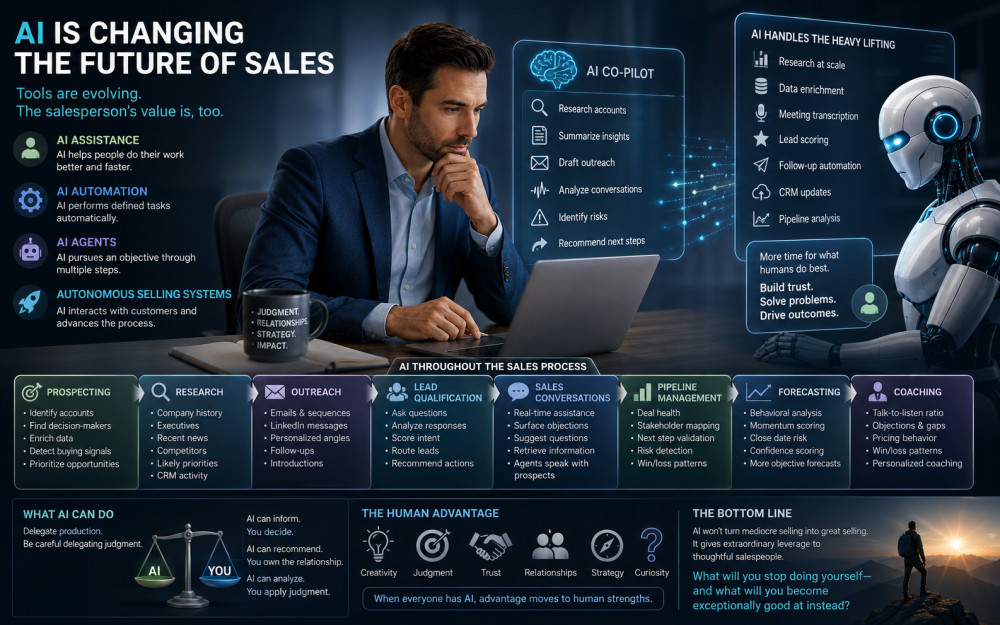
At the simplest level, there is AI assistance.
A salesperson asks AI to research an account, summarize a company, write an email, prepare questions, analyze a call transcript, create a proposal, or suggest an objection response.
The human remains firmly in control.
Then there is AI automation.
The system performs defined tasks automatically: enriching CRM records, scoring leads, transcribing meetings, generating follow-ups, routing inquiries, or identifying accounts exhibiting certain buying signals.
Beyond that are AI agents.
Instead of simply responding to one instruction, an agent can pursue an objective through multiple steps.
You might tell an agent:
“Identify companies in our market showing evidence that they are expanding their sales teams, find the likely decision-makers, research each account, and recommend the 20 we should contact first.”
The system may perform several activities to complete that assignment.
And we are now beginning to see autonomous selling systems capable of carrying on actual customer interactions.
Salesforce reported this year that AI and AI agents have become sales organizations' leading growth tactic for 2026. Nine in ten sales teams either use agents or expect to within two years, while top-performing teams are 1.7 times more likely than struggling teams to use them.
This is not theoretical anymore.
What Is AI Actually Being Used For?
The easiest way to understand AI in sales is to follow the sales process.
Prospecting
AI can identify potential accounts, analyze markets, enrich company information, locate decision-makers, prioritize prospects, and look for signals that something may be happening inside a company.
Instead of manually researching 100 companies, a salesperson can potentially investigate thousands and devote human attention to the most promising opportunities.
Research
Before an important conversation, AI can summarize:
- company history;
- executives;
- products;
- competitors;
- recent developments;
- previous conversations;
- CRM activity;
- likely priorities;
- industry conditions.
The salesperson walks into the meeting considerably more prepared.
Outreach
AI can generate emails, phone scripts, LinkedIn messages, follow-ups, introductions, and personalized talking points.
This is both extremely useful and extremely dangerous.
More on that shortly.
Lead qualification
AI can ask questions, analyze responses, score intent, route inquiries, recommend next actions, and potentially conduct early-stage qualification itself.
Sales conversations
AI systems can increasingly listen to customer conversations in real time, retrieve information, suggest questions, surface objections, identify competitive mentions, and provide representatives with assistance while the conversation is happening.
Other systems can speak directly with prospects through chat, voice, or digital agents.
Pipeline management
AI can examine deals and ask:
Has this opportunity actually advanced?
Are multiple stakeholders involved?
Was a next step agreed upon?
Has the close date repeatedly moved?
Has communication slowed?
Does this opportunity resemble deals we normally win—or deals we normally lose?
Forecasting
Traditional forecasting often depends heavily on what the salesperson believes will happen.
AI can add another layer by analyzing behavioral evidence surrounding the opportunity.
That doesn't necessarily make forecasts infallible.
It does make it harder for optimism alone to masquerade as pipeline.
Coaching
Imagine giving every salesperson access to someone who could review every sales conversation they ever had.
AI can identify talk-to-listen ratios, recurring objections, weak discovery, missed opportunities, pricing behavior, competitive patterns, and differences between successful and unsuccessful calls.
That could fundamentally alter sales development.
So Is AI Going to Replace Salespeople?
Some sales jobs will disappear.
It would be intellectually dishonest to pretend otherwise.
If someone's primary contribution is manually researching information, entering CRM data, sending highly templated outreach, answering routine questions, or performing repetitive administrative tasks, much of that work is becoming automatable.
But that does not necessarily mean the salesperson disappears.
It may mean the job changes.
Microsoft's 2026 Work Trend Index found that 66% of surveyed AI users said AI allows them to spend more time on high-value work. Microsoft argues that as agents take on more execution, human value increasingly shifts toward defining objectives, directing work, exercising judgment, and owning outcomes.
Salespeople should pay attention to that distinction.
The future sales professional may perform less administrative work but exercise considerably more judgment.
What Should You Let AI Do?
A useful rule is:
Delegate production. Be careful delegating judgment.
Let AI help:
- Research accounts.
- Summarize information.
- Organize notes.
- Generate first drafts.
- Analyze patterns.
- Prepare meetings.
- Update systems.
- Identify possibilities.
- Surface risks.
- Recommend questions.
- Then apply human judgment.
AI can tell you that an account appears attractive.
It cannot perfectly understand the politics inside that company.
AI can draft a negotiation response.
It does not own your relationship with the customer.
AI can identify an objection.
It may not understand what the buyer is afraid to say.
AI can recommend that you follow up.
It cannot always know when silence is strategically better.
Can Customers Tell When You Use AI?
Increasingly, yes.
Not because AI necessarily writes badly.
Quite the opposite.
AI often writes suspiciously well.
The problem is sameness.
Everyone suddenly sounds articulate.
Everyone “noticed your recent announcement.”
Everyone “loves what you're building.”
Everyone has “three quick thoughts.”
Everyone's email contains a perfectly constructed observation followed by an equally perfect transition into a sales pitch.
AI has made personalization dramatically easier.
That means superficial personalization is becoming dramatically less impressive.
The winners will use AI to understand prospects better rather than merely to create the appearance that they understand them.
What Happens When Everyone Has AI?
This may be the most important question.
AI provides an advantage today partly because adoption remains uneven.
Eventually, everyone will have excellent research.
Everyone will have writing assistance.
Everyone will have call summaries.
Everyone will have meeting preparation.
Everyone will have intelligent CRM tools.
What happens then?
The advantage moves elsewhere.
To creativity.
Judgment.
Domain expertise.
Trust.
Relationships.
Curiosity.
Strategy.
Original thinking.
And perhaps most importantly, the ability to recognize which opportunities deserve precious human attention.
AI Is Also Changing the Buyer
Sellers are not the only people using AI.
Gartner reported in 2026 that 45% of B2B buyers surveyed had used AI during a recent purchase. Buyers increasingly use AI to research vendors and products independently. At the same time, 69% said they prefer salespeople to validate AI-generated insights.
That creates a fascinating future.
The salesperson may no longer be the buyer's primary source of information.
Instead, the salesperson becomes the person who provides context, interpretation, validation, judgment, and confidence.
That is a much higher bar.
Where Should a Salesperson Begin?
Don't begin by asking:
“Which AI tools should I buy?”
Ask:
“Where does my time go?”
Then look for leverage.
If you spend three hours per week researching accounts, start there.
If CRM administration consumes enormous time, start there.
If meeting preparation is inconsistent, start there.
If follow-up gets forgotten, start there.
If you have hundreds of dormant opportunities nobody can intelligently prioritize, start there.
AI is most valuable when attached to a real problem.
Not when attached to a technology budget.
The Bottom Line
AI is not going to turn mediocre selling into great selling automatically.
It can make mediocre selling happen faster.
It can also give extraordinary leverage to thoughtful salespeople.
That distinction matters.
The salesperson who uses AI merely to produce more emails may discover that everyone else can produce more emails too.
The salesperson who uses AI to become better informed, better prepared, more responsive, more strategic, and more available for meaningful customer interaction may become dramatically more productive.
That is the real promise.
AI is not just another sales tool.
It is slowly changing the division of labor between salesperson and machine.
And the smartest question isn't whether AI belongs in sales anymore.
It already does.
The question is:
What are you going to stop doing yourself, and what are you going to become exceptionally good at doing instead?