How to Use Price Increases to Create Ethical Sales Urgency
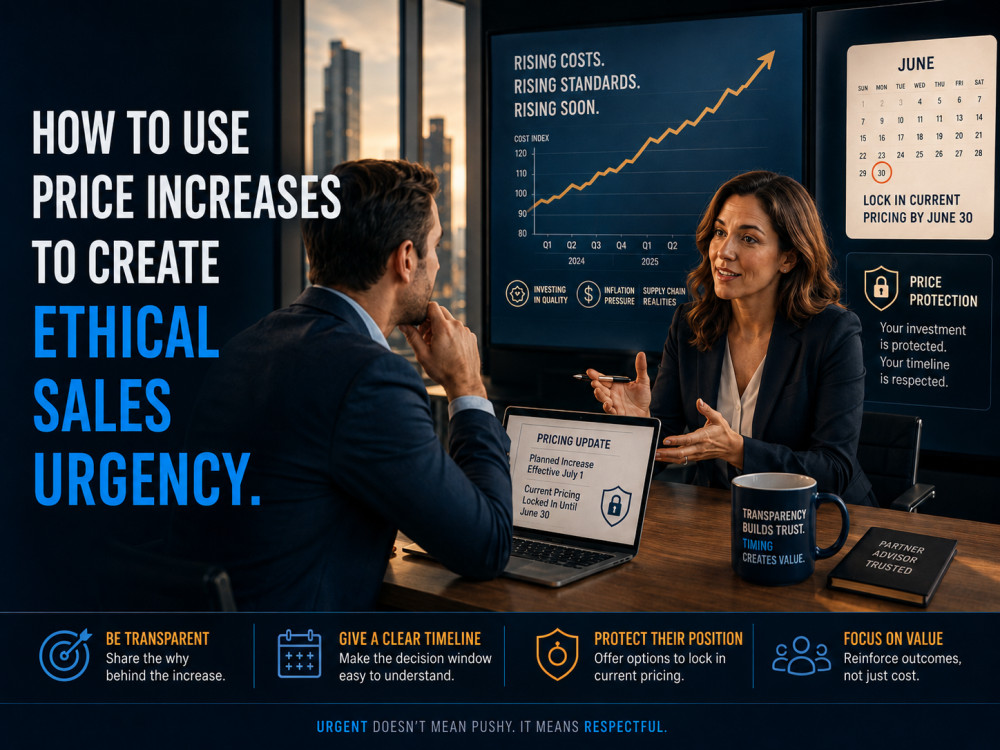
Inflation is back in the conversation, and not in the cute academic way where economists on cable news argue about basis points while everyone else wonders why a sandwich now costs $18.
The latest inflation report showed prices rising 3.8% year over year, nearly double the Federal Reserve’s long-standing 2% target. Energy was a major culprit, with the Bureau of Labor Statistics reporting that energy prices were up 17.9% from a year earlier, gasoline was up 28.4%, and fuel oil was up 54.3%.
That kind of inflationary pressure does not stay politely contained inside government reports. It travels. It moves through freight costs, raw materials, supplier contracts, manufacturing inputs, service delivery costs, wages, insurance, travel, logistics, and customer expectations. It reaches producers, vendors, distributors, agencies, manufacturers, service businesses, and ultimately buyers.
And when that happens, companies face the uncomfortable decision every business eventually faces: absorb the margin pressure or raise prices.
Neither option is especially fun. Absorbing costs can quietly strangle profitability. Raising prices can slow demand, invite scrutiny, trigger competitive comparisons, and make sales conversations more delicate. But there is another side to this: when handled correctly, the risk of future price increases can become a legitimate sales catalyst.
That sentence needs a little moral supervision.
Using potential price increases in sales is not about manipulating buyers. It is not about inventing fake scarcity, making up arbitrary deadlines, or turning every conversation into a Timeshare Presentation From Hell. It is about helping buyers understand a real economic reality: prices may rise, costs may change, and waiting can have consequences.
When done well, price-change messaging creates urgency without cheapening the relationship.
When done poorly, it sounds like: “Act now before this once-in-a-lifetime opportunity disappears forever,” which is the kind of sentence that makes normal adults want to fake their own death just to escape the follow-up sequence.
The difference is credibility.
A buyer will tolerate urgency when the urgency is real. They will resent urgency when it is theatrical.
In an inflationary environment, sellers have a very real reason to talk about timing. If input costs are rising, if supplier pricing is changing, if shipping costs are volatile, if labor costs are increasing, or if the company has already announced that pricing will be reviewed in the next quarter, then the sales team should not be afraid to say so.
In fact, failing to say so can be a disservice to the buyer.
If a customer is likely to pay more by waiting 30, 60, or 90 days, they deserve to know that. If a buyer can lock in current pricing by signing before a scheduled increase, that is not pressure. That is information. The pressure comes from reality, not from the salesperson.
This is where sales professionals need to understand the difference between manufactured urgency and economic urgency.
Manufactured urgency is seller-created. “This discount expires Friday.” “My manager only approved this today.” “We only have two spots left.” Sometimes those statements are true. Very often, they are just sales confetti thrown into the air because the rep needs a deal to close before month-end.
Economic urgency is market-created. Costs are rising. Supply is tightening. Pricing is being reset. Competitors are increasing rates. Freight is unstable. Materials are becoming more expensive. Labor is harder to secure. The cost of waiting is becoming measurable.
That kind of urgency is far more powerful because it does not depend on the salesperson being pushy. It depends on the buyer being rational.
The best version of this sales motion sounds something like this:
“Given where costs are moving, we are reviewing pricing for the second half of the year. I do not want to overstate this or turn it into a pressure tactic, but if this is already a priority for you, there may be a real advantage to locking in current pricing before those changes take effect.”
That is not sleazy. That is useful.
It is useful because it respects the buyer’s intelligence. It does not pretend the buyer is a panicked raccoon who will sign anything because the word “increase” appeared in an email. It simply makes the tradeoff visible.
The psychology behind this is straightforward. Buyers do not like losing optionality. They do not like paying more later for something they could have secured today. They do not like explaining to their boss that they delayed a decision and now the same product, service, or contract costs 8% more. That discomfort is not irrational. It is a normal response to avoidable loss.
Behavioral economists call this loss aversion. Normal people call it, “I hate feeling like an idiot.”
The fear of missing a lower price can be more motivating than the hope of getting a better deal later. That is why price increase notices can create movement in stalled pipelines. The buyer may have already believed in the solution. They may have already understood the value. They may have already wanted to move forward. But without a clear reason to act now, the decision drifted into the swamp of “next month.”
A credible future price increase gives the buyer a reason to pull the decision back into the present.
That matters because indecision is one of the greatest competitors in sales. Not always a named competitor. Not always a cheaper product. Often, the real competitor is delay. The buyer agrees there is a problem, agrees the solution makes sense, agrees the price is fair, and then somehow the whole thing gets eaten by calendars, committees, distractions, risk avoidance, and internal inertia.
Price movement can interrupt that drift.
But again, the tactic only works when it is handled with discipline.
Sales leaders should not simply tell the team, “Go out and tell everyone prices are going up.” That is how you end up with twelve different versions of the story, three angry prospects, one confused customer, and a Slack thread titled “Who told Acme their price was increasing by 20%?”
If price increases are going to become part of the sales motion, the company needs a clear internal framework.
First, leadership should define what is actually changing. Are prices definitely increasing, or are they under review? Which products, services, plans, contracts, territories, or customer segments are affected? What is the expected range? When does it take effect? Can current prospects lock in existing pricing? For how long? Does the offer apply to renewals, expansions, new business, or all three?
Ambiguity is dangerous. Salespeople are already gifted at creative interpretation when quota is involved. Do not hand them a fog machine and call it strategy.
Second, the company should define the approved language. Not a robotic script, but a set of principles and phrases that keep the message accurate, ethical, and consistent.
A good internal guidance note might say:
“We are currently evaluating pricing for Q3 due to increased input, labor, and operating costs. Prospects who move forward before June 30 may be eligible to lock in current pricing for the initial contract term. Do not guarantee a specific future increase unless approved. Do not imply scarcity that does not exist. Do not pressure buyers. Do explain that timing may affect pricing.”
That kind of clarity protects the business, the salesperson, and the buyer.
Third, sellers should connect the price conversation to value, not fear alone.
This is critical. If the only reason to buy now is “the price might go up,” the sales motion is weak. The buyer still needs to believe the solution is worth buying. A price increase can accelerate a decision, but it should not be the entire reason for the decision.
The better structure is: value first, timing second.
For example:
“We have already talked through how this could help reduce churn, improve sales visibility, and shorten onboarding time for new reps. The pricing piece is not the main reason to do this, but it may affect the timing. If this is something you already see as a fit, moving before the end of June could allow you to secure the current rate before the second-half pricing review.”
That is a much stronger message than: “Prices are going up, so buy now.”
The first version reinforces the business case. The second version sounds like someone selling patio furniture during a liquidation event.
Fourth, sellers should use price increases as a reason to re-engage stalled opportunities.
A stalled buyer is not always a dead buyer. Sometimes they are distracted. Sometimes the internal champion lost momentum. Sometimes the project got buried under more urgent priorities. A price-change notice gives the rep a legitimate reason to restart the conversation without sounding like they are just “checking in,” a phrase that should be sent to a remote island and forced to survive on coconuts.
A strong re-engagement note might look like this:
“I wanted to flag something timely. We are reviewing pricing for the second half of the year because of rising operating and delivery costs. Since we had already discussed this as a possible Q3 initiative, I wanted to make sure you had a chance to revisit it before any pricing changes take effect. No pressure if priorities have shifted, but there may be a meaningful advantage to locking in current pricing if this is still on your roadmap.”
That works because it is not needy. It is specific, relevant, and tied to a prior conversation.
Fifth, the sales team should be careful with tone. Price increase messaging should sound calm, not frantic. The more frantic the seller sounds, the less credible the message becomes. Buyers can smell desperation. It has a scent somewhere between burnt coffee and end-of-quarter LinkedIn posts.
The tone should be professional, factual, and advisory.
The seller’s posture should be: “I want you to have this information so you can make the best decision.”
Not: “I need you to buy before my forecast meeting turns into a public execution.”
The best reps can create urgency without transferring anxiety.
That is a subtle but important skill.
Sixth, companies should think about price-lock offers. In inflationary periods, a price lock can be a clean and valuable sales tool. It gives the buyer something concrete: sign by a certain date and secure current pricing for a defined period.
This is often more effective than discounting because it preserves price integrity. Instead of saying, “We will lower the price if you move faster,” the company says, “We will protect you from an increase if you move faster.”
That is a very different psychological frame.
Discounting teaches the buyer that the price is flexible. Price protection teaches the buyer that timing matters.
A price-lock offer might be especially useful for annual contracts, long-term service agreements, subscription plans, maintenance agreements, manufacturing commitments, agency retainers, or any category where cost inputs are moving and future pricing uncertainty is real.
But the offer must be bounded. “Lock in current pricing forever” is usually a bad idea unless your finance team has been replaced by golden retrievers. The better approach is to define the term: current pricing locked for 12 months, through the first contract term, through year-end, or for the initial scope only.
The cleaner the offer, the easier it is to sell.
Seventh, sellers should segment buyers by urgency and fit. Not every prospect should receive the same price-increase message. A high-intent opportunity already in proposal stage should hear it differently than a cold prospect who barely knows you exist.
For active opportunities, the message can be direct: “This may affect your current proposal timeline.”
For stalled opportunities, it can be framed as a timely reason to revisit.
For existing customers, it should be handled with more care, especially if renewals or expansions are involved. Existing customers do not want to feel ambushed. They need transparency, notice, and a clear explanation of what is changing and why.
For cold outbound, price increase messaging is usually weaker unless tied to a broader market insight. “Buy from us before our prices go up” is not a compelling cold email. But “Many companies are trying to secure vendor pricing before second-half cost increases hit” may be a useful entry point if the broader message is relevant.
Eighth, sales leaders should use price pressure to improve qualification.
A buyer who will not move despite a clear business case and a legitimate pricing deadline may not be a real opportunity. That does not mean they are bad people. It means the pain may not be strong enough, the timing may not be real, or the internal ownership may be weak.
Price-change urgency can reveal truth.
If the buyer says, “That is useful to know, but we still cannot prioritize this,” you have learned something. If they say, “We need to get legal involved this week,” you have learned something else. Either way, the conversation moves from vague interest to actual intent.
This is one of the hidden benefits of urgency: it forces clarity.
Sales pipelines are often clogged with opportunities that are not dead enough to remove and not alive enough to close. Price deadlines can help separate real buyers from professional ponderers.
Professional ponderers are the people who love to meet, love to discuss, love to explore, love to evaluate, and somehow never buy anything. They are not always obvious at first. They can be charming, curious, and very engaged. But they do not own urgency. They rent it for meetings.
A real price-change event can expose whether urgency exists inside the buyer’s organization or only inside the seller’s CRM.
Ninth, sellers should never overplay the inflation card.
Inflation is real. Cost pressure is real. Energy shocks are real. But buyers are not stupid. They know some companies use macro headlines as cover for opportunistic price increases. If the message feels opportunistic, it can backfire.
This is especially true if your category is not clearly affected by the cost increases you are citing. A trucking company can credibly talk about fuel costs. A manufacturer can credibly talk about raw materials and supply chain issues. A field service business can talk about labor, vehicles, insurance, and equipment. A software company needs to be more careful unless the price increase is tied to labor costs, infrastructure costs, support costs, product investment, or broader pricing strategy.
The more specific the rationale, the more credible the message.
“Due to inflation, prices are going up” is weak.
“Because our freight, installation labor, and material costs have increased materially, we are adjusting pricing for new projects beginning July 1” is much stronger.
Specificity builds trust.
Tenth, this tactic should be used to protect margin, not just pull deals forward.
There is a trap here. Companies may use price-increase urgency to generate a temporary spike in sales, but if they pair it with heavy discounting, sloppy terms, or poorly structured commitments, they can create future problems. Pulling deals forward at bad margins is not always a win. It can be a sugar high.
The goal should be high-quality urgency: buyers who already see the value, have a real use case, and can benefit from acting before pricing changes.
This is where sales leadership and finance need to be aligned. The sales team needs to know what they can offer, what they cannot offer, and what types of deals are worth accelerating. A panicked race to close anything before prices rise can create bad-fit customers, support burdens, churn risk, and margin leakage.
Urgency should sharpen discipline, not replace it.
For sales professionals, the lesson is simple: use price increases as a business conversation, not a closing gimmick.
A great salesperson can say:
“Here is what is changing. Here is why it matters. Here is how it may affect your timing. Here is what you can do if you want to protect current pricing. And if the timing is not right, that is okay — but I did not want you to be surprised later.”
That is the tone.
Advisory. Clear. Calm. Useful.
The deeper truth is that buyers often need help making decisions. Not because they are incapable, but because internal decision-making has become slow, crowded, and risk-averse. A credible price increase can help an internal champion build the case to act now. It gives them a concrete argument: “We can wait, but waiting may cost us more.”
That can be powerful.
It gives the buyer a reason to prioritize the decision internally. It gives the champion a reason to pull in finance. It gives the team a reason to compare the cost of action versus inaction. It gives the seller a reason to ask sharper questions.
But it has to be real.
There is no long-term advantage in training buyers not to trust your deadlines. If every quarter has a fake deadline, every deadline becomes noise. If every “price increase” is followed by an exception, buyers learn to wait. If every urgent message sounds like a hostage note written by a quota-carrying raccoon, credibility evaporates.
The strongest sales organizations protect urgency by using it honestly.
In an inflationary market, price is not just a number. It is a moving target. Buyers know this because they are experiencing it everywhere: in payroll, materials, insurance, energy, rent, travel, food, services, and household budgets. The sales opportunity is not to exploit that anxiety. The opportunity is to help buyers make better timing decisions in a world where waiting is no longer neutral.
That is the key idea: waiting is not always free.
When prices are stable, delay may feel harmless. When prices are rising, delay can become expensive. A strong salesperson helps the buyer see that clearly.
So yes, “prices are going up, lock in today’s rate” can be an effective message.
But the professional version is better:
“Based on where costs are moving, current pricing may not be available much longer. If this is already a priority, there may be a real financial advantage to moving now. My goal is not to pressure you, it is to make sure you have the information before the economics change.”
That is how you use price shifts tactfully.
Not as a scare tactic.
As a decision tool.