Outbound Is Not Dead. Lazy Outbound Is.
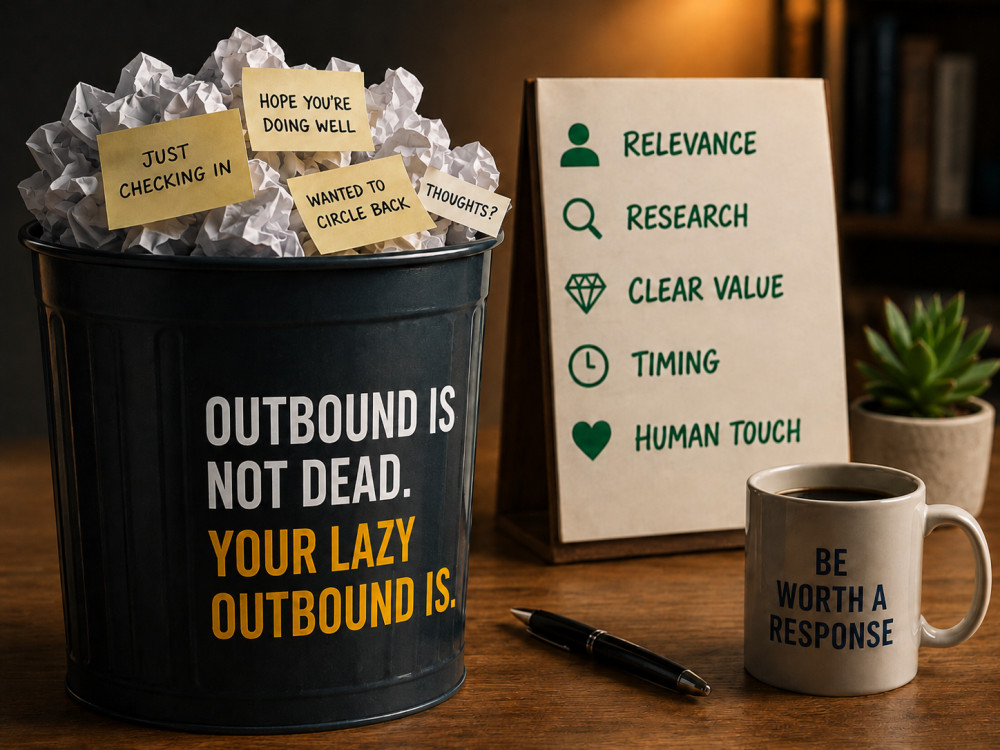
Outbound has been declared dead so many times it should have its own cemetery, complete with tiny little tombstones that say things like “Cold Calling, 1978–2026,” “Email Prospecting, 1996–2026,” and “Just Checking In, Unfortunately Still Alive.”
But outbound is not dead.
Lazy outbound is dead. Or at least it should be.
The distinction matters because many companies are still trying to solve a quality problem with a quantity hammer. Response rates are down? Send more emails. Buyers are ignoring us? Add another step to the sequence. Prospects are annoyed? Personalize the first sentence with something scraped from LinkedIn. “Saw you went to Michigan State…” Great. Very moving. Truly the Gettysburg Address of sales outreach.
The problem is not that buyers refuse to engage with sellers. The problem is that buyers refuse to engage with irrelevant sellers.
Gartner’s research that 67% of B2B buyers prefer a rep-free experience should scare bad outbound teams, but it should sharpen good ones. Buyers do not want to be interrupted by people who have done no thinking. They do not want generic claims, vague value propositions, or fake urgency. They do not want to be treated like a contact record wearing a Patagonia vest.
But buyers still respond to relevance.
That is the whole game.
The future of outbound belongs to salespeople who can form a credible point of view before reaching out. Not a fake point of view. Not a templated “I noticed your company is growing” point of view. A real one.
A good outbound message should feel like the sender understands why the conversation might matter now. It should connect a business trigger, a likely problem, a relevant outcome, and a reason to engage. It should not ask the buyer to do all the work.
Too much outbound is written from the seller’s perspective. “We help companies like yours…” “We are a leading provider…” “I wanted to introduce myself…” “Would you be open to learning more…” This is seller-centered language. It may be polite, but it is not compelling.
Buyer-centered outbound begins somewhere else: “Your team may be running into X because Y changed.” Or, “Companies in your position often hit this problem when they try to scale.” Or, “If you are seeing the same pattern we are seeing in the market, this may be worth comparing notes on.”
The goal is not to trick the buyer into a meeting. The goal is to earn the right to a conversation.
Sales leaders need to be honest about this. If your outbound team is failing, the answer may not be “hire hungrier SDRs.” Hunger is nice. But hunger without direction is just a raccoon in a garage.
Your team may have an ICP problem. A messaging problem. A list problem. A timing problem. A training problem. A management problem. A product-market clarity problem. Or, most commonly, a “we never actually defined what makes an account worth pursuing” problem.
Outbound performance is downstream from strategic clarity.
If the company cannot explain exactly who it helps, why those buyers care, what business pain exists, what event creates urgency, how the company is different, and what proof supports the claim, the SDR team will fill the gap with activity. Activity is the great camouflage of unclear strategy.
This is why AI can be either helpful or horrifying.
Used well, AI can help salespeople research accounts, identify patterns, synthesize public information, tailor outreach, generate better questions, and prepare for calls. Used poorly, it becomes a spam cannon with a thesaurus.
The average buyer can smell AI-generated outreach now. Not always because it is obviously robotic, but because it has the emotional texture of airport carpet. Clean enough. Functional enough. Completely forgettable.
Good outbound in 2026 needs specificity, brevity, and evidence. It also needs restraint.
Not every prospect deserves a 14-step sequence. Not every downloaded asset requires a phone call within seven minutes. Not every VP wants to receive the same message on email, LinkedIn, voicemail, carrier pigeon, and possibly smoke signal. Persistence is important, but there is a fine line between professional follow-up and becoming a minor weather event in someone’s inbox.
The best outbound teams will use fewer, better touches.
They will invest more time in account selection. They will segment more intelligently. They will test messaging by persona. They will write like humans. They will use phone calls thoughtfully. They will know when to break up. They will measure not just meetings booked, but meetings that convert into real opportunities.
This last point matters. A meeting is not automatically a win. Sales teams that over-incentivize meeting volume can accidentally create garbage calendars for Account Executives. The SDR hits quota. The AE loses faith. The buyer gets annoyed. The pipeline report looks temporarily healthy, which is one of the most dangerous forms of corporate fiction.
Outbound should be measured by contribution to real pipeline, not merely calendar debris.
For sales professionals, this is an opportunity. Most outbound is still bad. That means being good at it is a differentiator. If you can write clearly, research intelligently, call confidently, listen carefully, and adjust based on feedback, you are valuable.
You do not need to be a spam machine. You need to be a relevance machine.
A practical test: before reaching out to a prospect, ask yourself, “Would I send this exact message if I knew the buyer would print it out and read it aloud in front of my manager?” If the answer is no, improve it.
Another test: “Does this message contain a reason this buyer should care, or merely a reason I want a meeting?” If it is the latter, rewrite it.
The death of lazy outbound is not bad for sales. It is good for sales. It forces the profession to become more thoughtful. More disciplined. More business-literate. More respectful of the buyer’s time.
Outbound is not dead.
But the market is increasingly intolerant of outbound that deserves to be.
And frankly, good riddance.