The Buyer Does Not Want to Talk to You. That Might Be Good News.
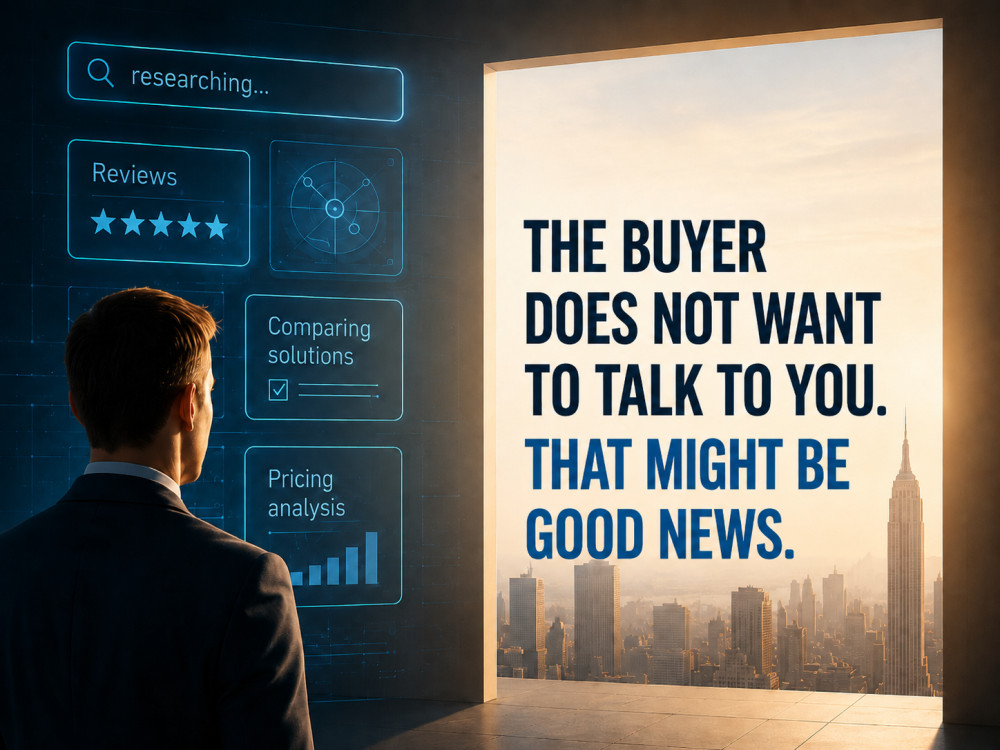
There is a strange little insult buried inside modern B2B sales data: a lot of buyers do not want to talk to salespeople.
According to Gartner, 67% of B2B buyers now say they prefer a rep-free experience. That does not mean 67% of buyers hate salespeople. It does not mean selling is dead. It does not mean every Account Executive should throw their laptop into a lake and open a hot dog stand. But it does mean something very important: buyers are increasingly trying to complete as much of the buying process as possible before they ever engage with a human being.
This is uncomfortable for sales leaders because the old model was built around access. Get the buyer on the phone. Get the meeting. Control the discovery. Control the presentation. Control the process. Control the follow-up. Control the close. But the buyer has been slowly stealing control for twenty years. AI just handed them the getaway car.
Buyers can now research your company, compare competitors, read reviews, summarize case studies, analyze pricing models, build vendor shortlists, and pressure-test claims without ever submitting a form, answering a cold call, or sitting through a “quick 15-minute intro.” Gartner also found that 45% of buyers used AI tools during a recent purchase, which means AI is not just something sales teams are using to write slightly more tolerable prospecting emails. Buyers are using it to evaluate sellers.
That changes the emotional architecture of sales.
For years, many sales organizations assumed the salesperson was the guide. The buyer had the problem, the salesperson had the expertise, and the sales process was a journey of education. That is still true in complex sales, but it is no longer the default. Today, many buyers arrive having already educated themselves. They do not need a guided tour of the lobby. They need someone who can explain why the foundation is cracked, why the basement smells funny, and whether the roof will survive winter.
That means the salesperson’s value is shifting from “information provider” to “decision-quality improver.”
A mediocre salesperson gives the buyer more information. A strong salesperson helps the buyer make a better decision. That distinction matters. Buyers already have information. In fact, many of them have too much information. They have comparison charts, blog posts, product videos, AI summaries, Reddit threads, analyst reports, LinkedIn opinions, and a procurement team that somehow manages to make everything more confusing while calling it governance.
The modern buyer is not always under-informed. Often, they are over-informed and under-confident.
This is where great salespeople still matter enormously. Not because they can recite features. Not because they can “circle back.” Not because they have mastered the sacred art of ending emails with “thoughts?” Great salespeople matter because they help buyers make sense of tradeoffs.
The sales professional of 2026 needs to be less like a brochure and more like a field surgeon. Diagnose quickly. Cut through noise. Explain risk. Prioritize what matters. Tell the truth about what will hurt. And, when necessary, say, “You may not actually need us yet.”
That last part is heresy in weak sales cultures, but it is a weapon in strong ones. Buyers are increasingly allergic to pressure. They do not want to be dragged into a seller’s funnel just because they downloaded a white paper called “2026 Strategic Growth Trends,” which, let’s be honest, probably said the same thing as every other white paper: AI, personalization, alignment, transformation, revenue acceleration, and a bar chart shaped like a hockey stick.
The rep-free buying trend does not mean buyers never want reps. It means they want control over when the rep enters the room.
This is why sales enablement has to change. Static content is not enough. A PDF case study hidden behind a form is not buyer enablement. A 37-slide deck with a company history section is not buyer enablement. A demo that spends the first 12 minutes explaining what the buyer already knows is not buyer enablement. Gartner’s framing is especially useful here: sales enablement must shift from static content toward AI-powered buyer support.
That sounds technical, but the practical meaning is simple: make it easier for buyers to evaluate you without begging for access.
Pricing clarity matters. Use-case clarity matters. Implementation clarity matters. Competitive positioning matters. ROI assumptions matter. Buyer-facing calculators matter. Honest “not a fit” language matters. Sales teams should not fear giving buyers more control; they should fear giving buyers vague, fluffy, incomplete, or self-serving information that causes them to quietly move on.
For sales leaders, this means your website, content, SDR motion, demo process, and AE discovery process can no longer operate as separate islands. The buyer does not experience your company as departments. They experience it as one continuous confidence-building or confidence-destroying machine.
For sales professionals, this is a call to upgrade your personal value. If your sales motion depends on having information the buyer cannot get elsewhere, you are in trouble. If your value is judgment, pattern recognition, business acumen, industry fluency, and the courage to tell the buyer what they actually need to hear, you are becoming more valuable, not less.
The irony is that rep-free buying may ultimately make great reps more important. When buyers finally do engage with a salesperson, their standards are higher. They have already done the easy part. They are not looking for someone to read the menu. They are looking for someone who knows which fish came in fresh this morning and which one has been sitting under a heat lamp since Tuesday.
So no, sales is not dead. But lazy sales is increasingly difficult to hide.
The buyer does not want to talk to you merely because you are available. They want to talk to you when you make the decision easier, safer, clearer, faster, or more profitable.
That is not bad news. That is the whole job.