The Sales Labor Market Is Thawing, But Nobody Should Get Relaxed
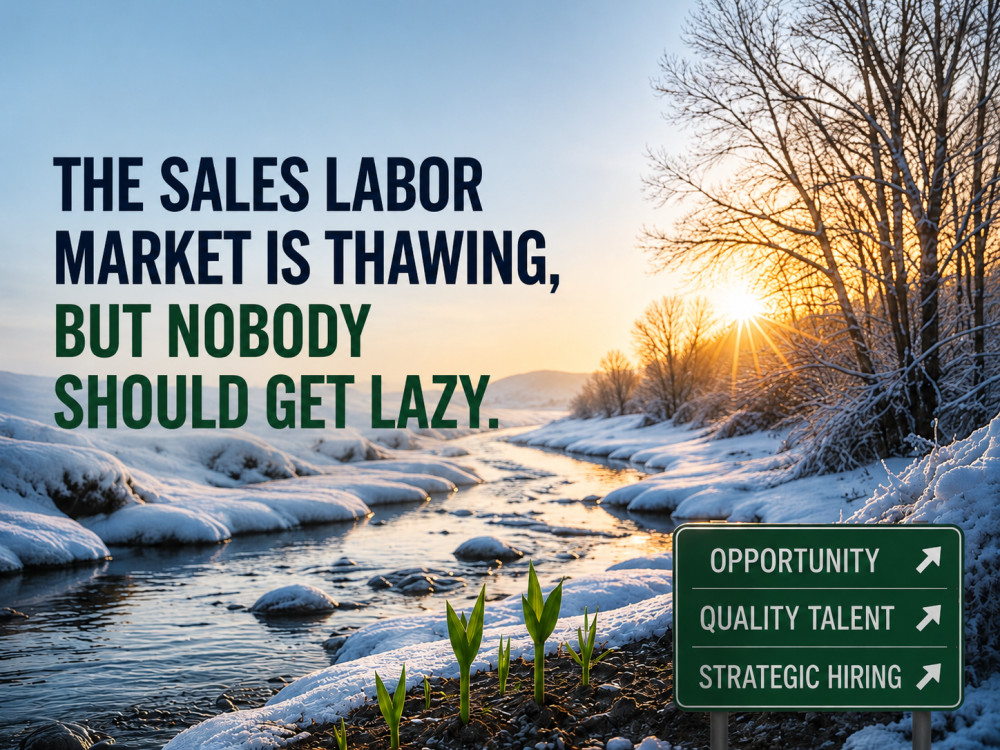
The labor market is sending mixed signals, which is exactly what labor markets like to do when they want business owners, recruiters, job seekers, and economists to collectively lose their minds.
On one hand, private-sector hiring showed signs of improvement this spring. ADP reported that U.S. private employers added 109,000 jobs in April 2026, the strongest monthly increase in 15 months. Reuters described the increase as consistent with a stable labor market, while also noting ongoing vulnerability due to broader economic and geopolitical uncertainty.
On the other hand, the job market is still weird. Job openings remain below the frenzy levels of 2021 and 2022. Employers are more cautious. Candidates are more cautious. AI is changing white-collar work. Some companies are hiring. Some companies are laying people off. Some are doing both at the same time, which is the corporate equivalent of stepping on the gas and the brake while calling it strategic transformation.
For sales leaders, this creates a dangerous temptation: assuming that because the market is not as hot as it once was, hiring great salespeople should now be easy.
It is not.
There may be more candidates available in some markets, but availability is not the same as quality. A larger stack of resumes does not automatically mean a stronger talent pool. Sometimes it just means more PDFs with inflated quota attainment claims, mysterious employment gaps, and LinkedIn headlines that say “Revenue Leader | Growth Architect | Strategic Storyteller | AI-Driven Transformation Evangelist,” which is often code for “currently open to work but trying to sound expensive.”
The best salespeople are still hard to find because the best salespeople are rarely sitting around waiting to be discovered. They are working. They are being paid. They are being retained. Or they are being very selective because they know a weak sales opportunity can waste a year of their career.
This is especially true in 2026 because the job itself is changing. The sales professionals who can thrive in an AI-influenced, buyer-controlled, research-heavy market are not interchangeable with the sales professionals who succeeded in a pure volume-based motion.
The market is not just asking, “Can this person sell?” It is asking, “Can this person sell now?”
That is a different question.
Can they sell to buyers who prefer self-service? Can they sell when the buyer has already researched three competitors before the first call? Can they sell when procurement is more involved? Can they sell when trials, proof, and risk reduction matter more than charisma? Forrester’s 2026 Buyer Insights work points to larger buying groups, more procurement influence, and trials becoming essential to reducing purchase risk.
In other words, the modern sales hire needs to be better at navigating complexity.
This has real implications for hiring. Sales leaders should be careful about overvaluing surface-level confidence. Confidence is not rare in sales candidates. If anything, sales interviews contain a dangerous surplus of confidence. The problem is not getting candidates to say they can sell. The problem is determining whether the confidence is attached to evidence.
A candidate who says, “I’m a hunter,” has told you almost nothing. A candidate who can explain how they selected target accounts, built a sequence, tested messaging, handled low response rates, adjusted based on market feedback, sourced internal champions, built a business case, navigated procurement, defended price, and closed a deal has told you much more.
The first candidate has a costume. The second candidate has a process.
For sales professionals, the same lesson applies in reverse. If you are looking for a stronger sales role this summer, do not assume that “the market is improving” means employers will overlook vague answers. The bar may actually be higher. Employers are under pressure to hire people who can produce faster, ramp intelligently, and operate with less hand-holding.
That does not mean pretending to be perfect. It means being specific.
If you are interviewing, be ready to talk through your actual sales motion. What was your territory? What was your ICP? What was your average deal size? Who was the buyer? What was the sales cycle? How did you prospect? How did you qualify? What objections came up? What tools did you use? What did you learn? Where did you struggle? What would your former manager say you did well, and what would they say you needed to improve?
The more specific you are, the more credible you become.
This is one of the great hiring divides in sales: vague candidates sound polished, but specific candidates sound real.
Sales leaders should also resist the urge to underpay simply because the market feels softer. If you want average, you can probably find average. If you want someone who can actually create revenue, compete in a noisy market, and represent your company well in front of skeptical buyers, compensation still matters.
That does not always mean throwing money at the problem. It means creating a believable earning path. Sales candidates understand risk. They know startups, territory rebuilds, new categories, long sales cycles, weak inbound, and messy CRM data all create ramp risk. If the compensation plan does not acknowledge that risk, strong candidates will quietly move on.
This is especially important for roles with heavy outbound requirements. Outbound is work. Real outbound is not just sending automated emails. It is research, targeting, messaging, calling, follow-up, rejection tolerance, testing, and self-management. If a company wants a salesperson to build pipeline from scratch, the opportunity needs to be credible enough to justify the effort.
A thawing labor market may help employers, but it does not eliminate the need for a compelling job offer.
The best sales hiring strategy in June 2026 is not “post and pray.” It is not “wait for unicorns.” It is not “hire the person with the most impressive logo history.” It is disciplined role design.
What exactly does success look like in the first 90 days? What sales motion is required? What customer problem is being solved? What proof does the company have? What resources will the salesperson receive? What is the manager’s role in helping them ramp? What is realistic compensation? What traits are truly required, and what traits are merely decorative?
Companies often blame the candidate market when the real issue is role confusion.
Candidates, meanwhile, should remember that employers are not merely hiring a resume. They are buying confidence. Confidence that you understand the work. Confidence that you can represent the company. Confidence that you can handle rejection. Confidence that you can learn the market. Confidence that you can create pipeline. Confidence that you will not need three hours of emotional support every time a prospect says no.
The sales labor market may be thawing, but great sales hiring remains hard because great selling remains hard.
That is the part everyone should respect.